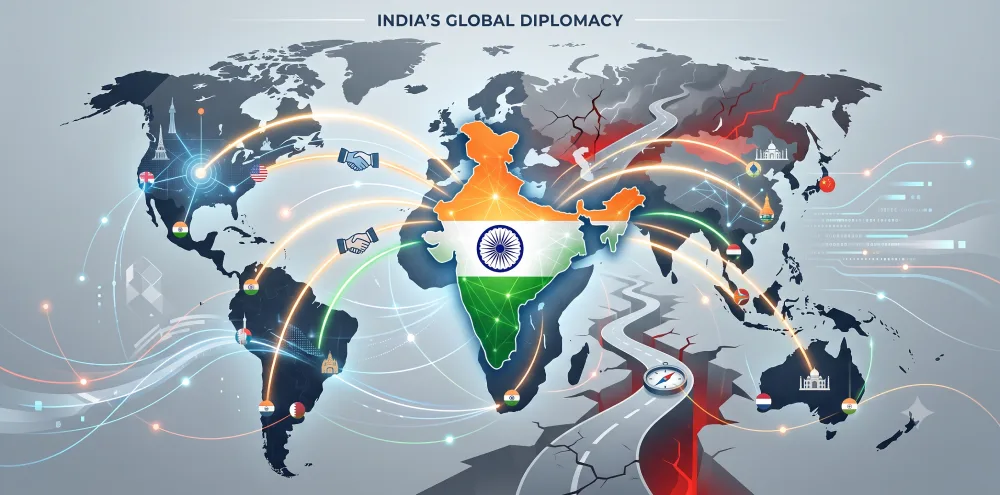
India is rapidly enhancing its presence on the global stage. Its proactive foreign policy focuses on strengthening existing alliances and forging new strategic partnerships. This dynamic approach is crucial for national development and regional stability. A recent Free Trade Agreement (FTA) with New Zealand exemplifies this outward-looking strategy. This deal signals a significant step in India’s Global Diplomacy, aiming to deepen economic and strategic cooperation. Such efforts are particularly vital in an increasingly complex international environment, marked by both opportunities for collaboration and persistent geopolitical tensions.
The nation’s diplomatic endeavors are not limited to trade pacts. India is also navigating a world fraught with significant geopolitical challenges. These include volatile situations in critical maritime routes and the ramifications of charged international rhetoric. Therefore, understanding India’s multi-faceted diplomatic engagements is essential. This includes examining how it balances its economic ambitions with its role as a responsible global actor. It also involves analyzing its responses to critical international developments.
📋 Quick Details
| FTA Partner 1 | New Zealand |
|---|---|
| FTA Partner 2 | India |
| New Zealand Partnership Status | Strategic |
| Pacts Signed (NZ) | 18 |
| PM Modi Australia Visit | Melbourne Cricket Ground |
| US-Iran Strait Issue | Strait of Hormuz |
| US Demand to Iran | Public declaration on shipping |
| Trump's Iran Threat | Retaliation for assassination |
India-New Zealand Free Trade Agreement: A Historic Milestone
The recent Free Trade Agreement between India and New Zealand represents a landmark achievement. Prime Minister Modi heralded this pact as a “historic milestone.” It signifies a new chapter in the bilateral relationship between these two nations. Both countries anticipate that this agreement will substantially deepen their bilateral ties. This includes enhancing economic cooperation and fostering greater strategic alignment across various sectors.
Historically, India and New Zealand have maintained cordial relations. However, their economic engagement had not yet reached its full potential. The FTA aims to unlock this potential. It seeks to reduce trade barriers, facilitate investment flows, and encourage collaboration in emerging areas. Furthermore, this agreement provides Indian businesses with enhanced access to the New Zealand market. Similarly, it offers New Zealand exporters greater opportunities in India’s vast and growing economy.
Prime Minister Modi’s visit to New Zealand underscored the importance of this agreement. During his visit, he received a ceremonial Maori welcome. This gesture symbolized the cultural respect and warmth between the two nations. More significantly, the visit elevated the ties between India and New Zealand to a strategic partnership. This upgrade signifies a more comprehensive and long-term commitment. It extends beyond mere trade relations into areas of shared strategic interest.
A “Roadmap to 2030” was also a key outcome of the visit. This ambitious plan outlines specific goals and timelines for future cooperation. It covers a wide array of fields, including defence, trade, and security. Specifically, India and New Zealand sealed 18 pacts during the visit. These agreements lay a solid foundation for intensified collaboration over the coming decade. They aim to boost two-way trade, strengthen security dialogues, and foster greater people-to-people connections.
The defence pacts, for example, could involve joint exercises and intelligence sharing. These initiatives are crucial for regional security, particularly in the Indo-Pacific. Trade agreements target specific sectors, such as agriculture, education, and technology. They promise mutual benefits and increased economic integration. Overall, the FTA with New Zealand is a testament to India’s commitment to expanding its economic footprint and diplomatic influence. It aligns with India’s broader vision of a multipolar world where diverse partnerships thrive.
The agreement is expected to significantly boost trade volumes. It will reduce tariffs on a range of goods, making them more competitive. This benefits consumers and businesses in both countries. Furthermore, it creates new avenues for services trade, particularly in IT and education. New Zealand’s expertise in agriculture and dairy, for instance, could find new markets in India. Meanwhile, India’s strengths in software and pharmaceuticals could see greater penetration in New Zealand.
Beyond economics, the strategic partnership holds considerable weight. Both nations share democratic values and a commitment to a rules-based international order. Therefore, closer security cooperation can contribute to regional stability. This is especially relevant in the context of evolving geopolitical dynamics in the Indo-Pacific. Regular high-level dialogues and exchanges will further solidify these ties. This proactive engagement strengthens India’s position as a key player in the global arena. It also demonstrates its willingness to build robust and meaningful bilateral relationships.
Strengthening India’s Global Diplomacy Through Bilateral Engagements
India’s Global Diplomacy is characterized by its emphasis on diverse bilateral engagements. These partnerships are instrumental in projecting India’s soft power and securing its strategic interests. The nation’s approach involves building trust, fostering economic cooperation, and collaborating on shared challenges. This strategy enables India to navigate the complexities of international relations effectively. It also positions India as a reliable partner in a multipolar world.
India understands the importance of strong relationships with a variety of nations. This helps in diversifying its foreign policy options. It also reduces reliance on any single power bloc. Consequently, India actively seeks to engage with countries across different continents and economic spectrums. These engagements range from comprehensive strategic partnerships to specific sectoral collaborations. Each relationship is carefully nurtured to yield mutual benefits and strengthen global frameworks.
Moreover, India often uses cultural exchange and people-to-people connections as diplomatic tools. Such initiatives build a deeper understanding and goodwill between nations. They create a foundation of shared values and experiences. This approach complements formal diplomatic efforts. It also helps in cultivating long-term relationships that transcend political changes. For example, the Indian diaspora plays a significant role in fostering these connections. They serve as cultural ambassadors, bridging gaps between India and their host countries.
Deepening Bilateral Ties: India and Australia’s Shared Passion
India’s relationship with Australia is another prime example of its deepening bilateral ties. Prime Minister Modi’s visit to Australia, including the iconic Melbourne Cricket Ground (MCG), highlighted the unique bond between the two countries. Cricket, often described as a “shared passion,” serves as a powerful symbol of cultural affinity. However, the partnership extends far beyond the sporting arena. It encompasses robust strategic, economic, and security dimensions.
The visit to the MCG, a significant sporting event, was more than just symbolic. It underscored the growing convergence of interests between India and Australia. Both nations are key players in the Indo-Pacific region. They share concerns about regional stability and maritime security. Consequently, their strategic partnership has evolved significantly over the past decade. It has moved beyond traditional areas to include critical technologies and defence cooperation.
The India-Australia partnership is a cornerstone of India’s Indo-Pacific strategy. This strategy emphasizes a free, open, and inclusive Indo-Pacific. Bilateral and multilateral mechanisms, such as the Quad, reinforce this vision. Discussions during high-level visits often focus on enhancing defence exchanges, intelligence sharing, and maritime domain awareness. These efforts are crucial for maintaining peace and prosperity in the region.
Economic ties are also flourishing. While trade volumes continue to grow, there is still immense untapped potential. Areas like critical minerals, renewable energy, and education offer significant opportunities. The historical context of uranium sales also reflects this evolving relationship. In 2011, Australia approved uranium sales to India. This decision marked a significant shift in Australia’s long-standing policy. It recognized India’s growing energy needs and its commitment to nuclear non-proliferation.
While the Congress in India debated the BJP’s claim of a ‘Modi breakthrough’ regarding uranium sales, the fact remains that such cooperation signals deepening trust. The partnership extends beyond ‘curry, cricket, and Commonwealth’ to encompass a more profound strategic alignment. It reflects a shared commitment to democratic values and a rules-based international order. This comprehensive engagement strengthens India’s global diplomatic outreach and its influence in key regional forums.
Education is another vital pillar of this relationship. A large number of Indian students choose Australia for higher education. This fosters cultural exchange and strengthens people-to-people links. Research collaborations between universities are also increasing. These partnerships contribute to innovation and knowledge sharing. Both countries recognize the importance of investing in human capital for future growth.
Defence cooperation has seen remarkable progress. Joint military exercises and naval patrols are becoming more frequent. This enhances interoperability and builds mutual confidence. Both nations are committed to tackling common security challenges, including terrorism and cyber threats. Furthermore, dialogues on regional security architecture are regular. These discussions aim to foster a stable and secure environment in the Indo-Pacific. The strategic alignment between India and Australia is a critical component of India’s Global Diplomacy, demonstrating its commitment to strong alliances.
Navigating Complex Geopolitical Landscapes: The US-Iran Flashpoints
While India builds bridges through bilateral engagements, the global landscape remains marked by significant geopolitical flashpoints. One of the most persistent and volatile tensions exists between the United States and Iran. This ongoing standoff has far-reaching implications for global energy markets, maritime security, and regional stability. It presents a complex challenge for international diplomacy, requiring careful navigation from all global actors, including India.
The relationship between the US and Iran has been fraught with hostility for decades. Recent developments, however, have intensified the rhetoric and heightened the risk of escalation. Statements from key political figures, coupled with intelligence reports, paint a picture of deep mistrust and potential confrontation. This situation underscores the fragility of peace in critical regions and the need for de-escalation through diplomatic channels.
The Strait of Hormuz: A Critical Maritime Chokepoint
A central point of contention in the US-Iran standoff is the Strait of Hormuz. This narrow waterway is strategically vital for global energy supplies. It connects the Persian Gulf to the open ocean, making it a critical chokepoint for oil shipments. A significant portion of the world’s seaborne oil passes through this strait daily. Therefore, any disruption here has immediate and severe repercussions for global markets and economies.
The US has consistently demanded that Iran pledge to stop shooting at ships in the Strait of Hormuz. This demand comes amidst a backdrop of several incidents involving commercial vessels in the area. These incidents have raised concerns about the safety of international shipping. They also threaten the freedom of navigation, a fundamental principle of maritime law. Consequently, the international community watches this situation with considerable apprehension.
US officials have specifically called for Iran to make a public statement. They want Iran to declare that the Strait of Hormuz is open for all ships and that it will not attack them. This public declaration is seen as a necessary step to de-escalate tensions and reassure the international community. Iran, however, views the strait as part of its territorial waters. It maintains the right to control passage under certain circumstances. This difference in interpretation complicates efforts to ensure smooth navigation.
The repeated incidents in the strait, including seizures of tankers and alleged attacks, underscore the precarious situation. Each event carries the risk of miscalculation and broader conflict. International efforts aim to secure the shipping lanes and prevent further escalation. However, achieving this requires significant diplomatic engagement and a willingness from all parties to adhere to international norms. The ongoing uncertainty highlights the challenges in maintaining stability in crucial maritime trade routes.
Controversial Rhetoric and Assassination Allegations
The tensions between the US and Iran have been further exacerbated by highly controversial rhetoric. Former US President Donald Trump recently revealed extreme revenge instructions. He stated that if he were assassinated, he would order to “Bomb Iran like never before.” These startling remarks underscore the intense animosity and the potential for severe escalation should such an event occur. His statements have drawn widespread criticism and concern from international observers.
Trump’s comments followed claims of an Iranian plot to assassinate him. Reports from the Wall Street Journal, citing sources, indicated that Israel had shared intelligence with the US regarding a fresh Iranian plot. This intelligence alleged that Iran was indeed hatching a plan to kill Trump. Such claims, whether substantiated or not, contribute significantly to the atmosphere of distrust and heightened alert between the two nations. They fuel fears of covert operations and retaliatory actions.
News outlets like CNN and The Times of India reported on this intelligence sharing. They discussed whether Israel was pushing the US to attack Iran by providing this information. This raises questions about the motivations behind intelligence disclosures in sensitive geopolitical contexts. Furthermore, it highlights the complex web of alliances and rivalries in the Middle East. The potential for a proxy conflict or a direct confrontation remains a significant concern for global security.
The implications of such threats and allegations are profound. They not only escalate the immediate tensions but also set a dangerous precedent for international relations. The use of inflammatory language by leaders can undermine diplomatic efforts. It can also increase the likelihood of miscalculation. Consequently, the international community often calls for restraint and adherence to diplomatic norms. The volatile nature of this rivalry requires continuous vigilance and concerted efforts towards de-escalation.
The claims of assassination plots introduce a personal dimension to an already complex geopolitical struggle. This makes resolution even more difficult. It creates a cycle of suspicion and threats, potentially trapping both nations in a dangerous standoff. The interplay between domestic politics in both countries and their foreign policy decisions also complicates the situation. Therefore, understanding the nuances of these developments is crucial for anyone following global affairs.
India’s Strategic Autonomy and Future of Global Diplomacy
In the face of complex international relations and volatile geopolitical flashpoints, India maintains its commitment to strategic autonomy. This principle guides India’s Global Diplomacy. It allows India to make independent foreign policy decisions. These decisions are based on its national interests, rather than aligning with any single power bloc. This approach positions India as a crucial voice for peace and stability in a fragmented world.
India actively promotes multilateralism. It believes in resolving international disputes through dialogue and established global frameworks. Therefore, it engages robustly with organizations like the United Nations, G20, and BRICS. These platforms provide opportunities for India to advocate for its perspectives. They also allow it to contribute to global governance. This commitment to multilateralism underscores India’s role as a responsible global stakeholder.
The nation’s growing economic prowess also strengthens its diplomatic standing. A robust economy provides the leverage needed to pursue an independent foreign policy. It also enables India to extend aid and development assistance to other nations. This further enhances its soft power and global influence. Consequently, India is increasingly seen as a significant partner in tackling global challenges such as climate change, poverty, and health crises.
India’s commitment to democratic values also resonates globally. As the world’s largest democracy, it champions human rights and the rule of law. This moral authority adds weight to its diplomatic efforts. It allows India to build partnerships based on shared values. Furthermore, India’s cultural heritage and diverse society are sources of strength. They provide a rich tapestry for cultural diplomacy, fostering understanding across borders.
Domestic Political Currents: Reflections Amidst Global Focus
While India actively pursues its global diplomatic agenda, domestic political developments continue to shape its internal landscape. These internal dynamics often provide a backdrop to the nation’s international engagements. Leaders’ statements and electoral processes reflect the vibrant democratic ethos of the country. They also highlight the constant interplay between national politics and global aspirations.
In West Bengal, Chief Minister Mamata Banerjee recently released a powerful video message. Amidst a crisis within the Trinamool Congress (TMC), she made a defiant statement. She asserted, “To silence me, you’d have to kill me.” This strong rhetoric was directed at the BJP. It underscores the intense political rivalry between the TMC and the BJP in the state. Her warning to dissident TMC leaders was clear: “Stay with party or join BJP.” This indicates internal challenges within the party, coupled with external pressure from the opposition.
Elsewhere, in Bihar, political maneuvering also captured headlines. A BJP candidate dropped out of the Bankipur bypoll race against political strategist Prashant Kishor. This withdrawal led to the BJP replacing its candidate just a day after nomination. Prashant Kishor, a prominent political consultant now entering active politics, was quick to comment. He suggested that the BJP was “struggling” in Bankipur. These events highlight the dynamic and often unpredictable nature of Indian state politics.
These domestic political currents, though seemingly separate from high diplomacy, are intrinsically linked. A stable and confident domestic political environment strengthens a nation’s hand in international negotiations. Conversely, internal turmoil can sometimes distract from external engagements. Therefore, the ongoing political debates and electoral battles are crucial for understanding the holistic picture of India’s journey.
The intensity of political discourse, as seen in Mamata Banerjee’s remarks, reflects the passionate nature of Indian democracy. Similarly, the strategic decisions made by political parties in by-elections illustrate the continuous electoral competition. These events, while local in nature, contribute to the broader narrative of India’s governance and its capacity to manage both internal and external affairs. Such vibrant political activity is a hallmark of India’s democratic system, which underpins its growing influence globally.
Conclusion
India’s journey on the global stage is marked by a dynamic and assertive foreign policy. The recent Free Trade Agreement with New Zealand symbolizes India’s commitment to deepening bilateral ties. It also demonstrates its proactive approach to economic integration. Furthermore, India’s strategic partnership with Australia reflects a broader vision for a stable and prosperous Indo-Pacific. These engagements are vital components of India’s Global Diplomacy, fostering cooperation and mutual growth.
However, the international arena remains complex, as evidenced by the persistent US-Iran tensions. The volatile situation in the Strait of Hormuz and the exchange of heated rhetoric highlight significant geopolitical challenges. These global flashpoints demand careful navigation and a steadfast commitment to peaceful resolution. India’s adherence to strategic autonomy and multilateralism positions it as a key voice in addressing these global issues. Its efforts are crucial for promoting peace and stability.
Ultimately, India’s ability to balance its economic ambitions with its role as a responsible global actor will define its future trajectory. The interplay of robust bilateral engagements, a principled stand on global issues, and a vibrant domestic political scene shapes this narrative. India continues to strengthen its international presence, contributing significantly to a more interconnected and cooperative world. Its diplomatic endeavors are paving the way for a more influential role in shaping global affairs.
For more real-time news updates and announcements, visit our homepage.