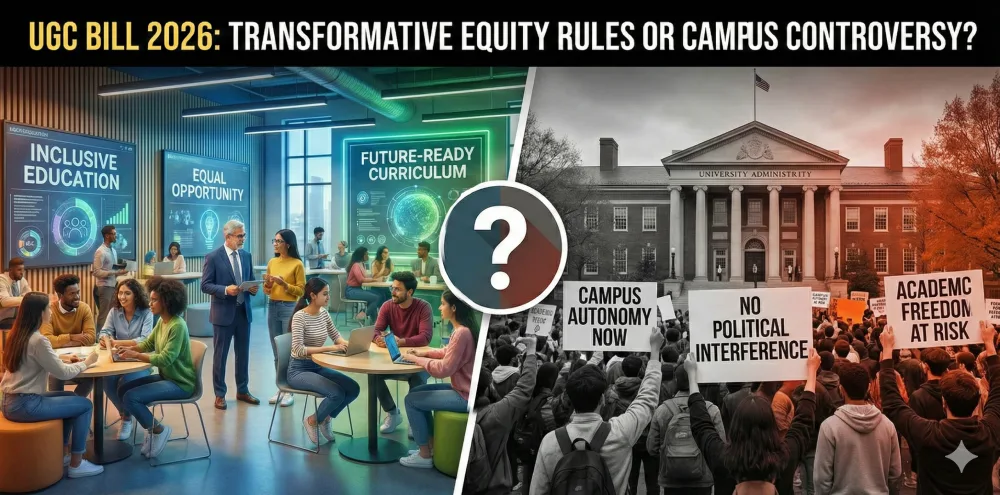
The landscape of Indian higher education is undergoing a seismic shift. For years, campus discrimination was handled via “advisories” that often lacked teeth. However, the introduction of the UGC Bill (Promotion of Equity in Higher Education Institutions) Regulations, 2026 has changed the game entirely.While the government envisions a discrimination-free future, the bill has sparked intense national debate, student protests, and even a temporary stay by the Supreme Court of India. Whether you are a student, a faculty member, or an institution head, understanding these new mandates is no longer optional—it is essential.
Key Takeaways
- Focus: Mandatory elimination of caste-based discrimination (SC, ST, and now OBC).
- Infrastructure: Every HEI must establish an Equal Opportunity Centre (EOC) and an Equity Committee.
- Deadlines: Complaints must be acknowledged within 24 hours and resolved within 15 working days.
- Penalties: Non-compliant colleges face withdrawal of grants and recognition.
- Current Status: As of February 2026, the Supreme Court has placed a stay on specific clauses due to concerns over “broad definitions.”
What is the UGC Bill 2026?
The UGC Bill 2026 (formally the Promotion of Equity Regulations) replaces the outdated 2012 framework. Its primary mission is to align Indian universities with the National Education Policy (NEP) 2020, specifically focusing on “Equity and Inclusion.”
Unlike previous guidelines, these rules are enforceable. They transition “equity” from a moral suggestion to a legal duty for every Higher Education Institution (HEI) in India, including private and deemed universities.
Comparison: 2012 Guidelines vs. 2026 Regulations
| Feature | 2012 Guidelines | 2026 Regulations |
| Nature | Advisory/Recommendation | Mandatory/Enforceable |
| Scope of Groups | Primarily SC/ST | SC, ST, OBC, Women, and PwD |
| Accountability | Not clearly defined | Head of Institution (VC/Principal) |
| Grievance Redressal | General/Slow | 24/7 Helpline & 15-day resolution |
| Punitive Action | Limited | Withdrawal of Grants & Recognition |
5 Critical Features of the New UGC Rules
The 2026 regulations mandate several structural changes to ensure that marginalized students feel safe and supported on campus.
- Equal Opportunity Centres (EOC): These serve as the nodal agency on campus to guide students and manage discrimination complaints.
- Equity Squads: Mobile teams that monitor “vulnerable zones” like hostels and dining halls to prevent harassment.
- Mandatory Undertakings: Every student and staff member must sign a declaration pledging not to engage in discriminatory behavior.
- Equity Ambassadors: Student representatives appointed to bridge the gap between administration and the student body.
- Direct Accountability: The Vice-Chancellor or Principal is now personally responsible for implementation.
The Controversy: Why the Supreme Court Stepped In
While the intent is noble, the UGC Bill 2026 has faced significant pushback. In late January 2026, the Supreme Court stayed the regulations, citing several legal and social concerns.
Summary of Institutional Responsibilities
| Requirement | Description |
| 24/7 Helpline | Must be accessible to all students for reporting bias. |
| Equity Committee | Chaired by the Head of Institution; must include diverse representatives. |
| Annual Reports | HEIs must submit detailed compliance reports to the UGC. |
| National Monitoring | A UGC-led committee will conduct surprise campus audits. |
Frequently Asked Questions (FAQ)
==>Yes. The regulations apply to all HEIs recognized by the UGC, including Central, State, Deemed, and Private universities across India.
==>Under the new rules, the UGC can withhold all financial grants, prohibit new programs, or even cancel recognition entirely.
==>Previous frameworks often focused on SC/ST categories. The 2026 bill explicitly includes Other Backward Classes (OBC) to address growing reports of bias in elite institutions.
Join the Conversation
What are your thoughts on the new “Equity Squads” on campus? Do you think they will make universities safer, or are they a threat to campus freedom?
Share your opinion in the comments below, and subscribe to our newsletter for the latest updates on education policy!