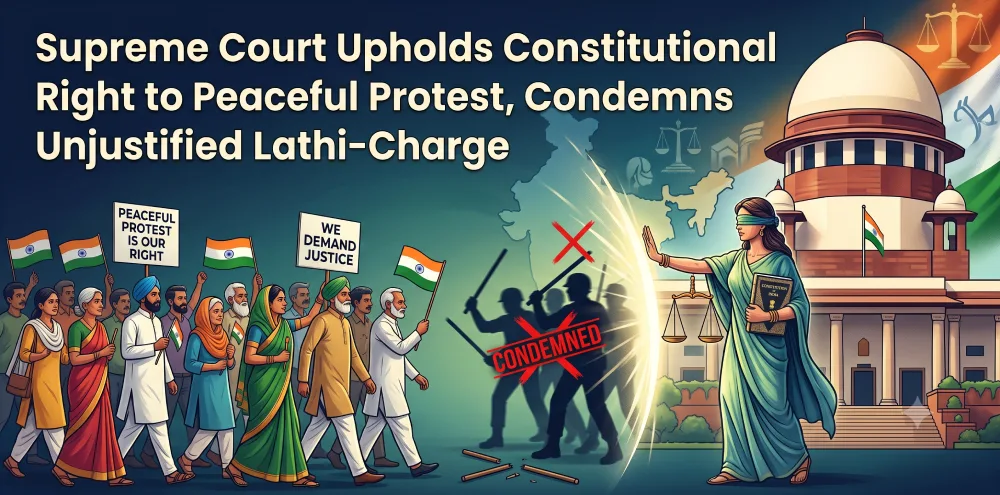
The Supreme Court of India recently delivered a landmark observation. It firmly stated that mere agitation cannot justify lathi-charge. This significant pronouncement came during a hearing regarding alleged police excesses during student protests. Specifically, these were demonstrations related to the National Eligibility cum Entrance Test (NEET). This ruling strongly reaffirms the fundamental democratic values enshrined in the Indian Constitution. It underscores the judiciary’s critical role in safeguarding civil liberties. The court’s stance reinforces the inherent Right to Peaceful Protest as a cornerstone of a functioning democracy.
Chief Justice of India (CJI) Surya Kant spearheaded these crucial remarks. He emphasized that peaceful protests are constitutionally protected. This means authorities cannot use force simply because people are expressing dissent. The apex court fixed a hearing on July 28 to address the police actions. This commitment demonstrates a serious intent to examine alleged violations. Many observers believe this decision will have far-reaching implications for public demonstrations across the country. It provides a clearer guideline for law enforcement agencies.
The Constitutional Imperative: Protecting the Right to Peaceful Protest
India’s Constitution provides its citizens with essential fundamental rights. These rights are vital for a healthy democracy. Among them, the Right to Peaceful Protest holds a special place. Article 19(1)(a) guarantees freedom of speech and expression. Article 19(1)(b) ensures the right to assemble peaceably and without arms. These provisions collectively form the bedrock for citizens to voice grievances. They allow individuals to challenge government policies without fear. However, these rights are not absolute. They come with reasonable restrictions.
Such restrictions often relate to public order, morality, or the sovereignty and integrity of India. The challenge lies in balancing these aspects. Courts frequently interpret where the line is drawn. The Supreme Court’s latest observation clarifies this balance. It specifies that “agitation” alone does not cross this line. Therefore, it cannot be a blanket justification for using force like lathi-charge. This distinction is crucial for understanding the limits of state power.
Throughout India’s history, protests have been integral to social and political change. Mahatma Gandhi’s non-violent movements exemplified this power. Post-independence, various movements continued this tradition. Student movements, farmers’ protests, and civil rights demonstrations have all shaped policy. The court’s current ruling builds on a long lineage of judicial pronouncements. It consistently upholds the citizen’s right to dissent. This legal heritage strengthens India’s democratic fabric.
Context of the Ruling: NEET Protests and Police Action
The immediate catalyst for the Supreme Court’s intervention was the NEET protest. Students across the nation expressed their discontent. Concerns about exam fairness and other related issues led to widespread demonstrations. In Bihar, specifically, reports emerged of police using excessive force. These reports included instances of lathi-charge against student protesters. Such actions sparked national outrage and drew judicial attention.
One particular incident gained significant media traction. A Bihar police officer was allegedly captured on camera firing an AK-47 at protesting students. This shocking footage led to the officer’s suspension. This incident highlighted serious concerns about police conduct. It raised questions about the proportionality of force used. Furthermore, it underscored the need for accountability within law enforcement. Such events erode public trust in state institutions.
Law enforcement agencies have a difficult job. They must maintain peace and order. They also need to protect public property. However, they must do so within constitutional limits. The Supreme Court’s remarks serve as a vital reminder. Police actions must be judicious and proportionate. They cannot resort to violence against peaceful assemblies. Training and sensitization of police forces become even more important in this light. Ensuring adherence to human rights standards is paramount.
Legal Implications of the Supreme Court’s Stance on the Right to Peaceful Protest
CJI Surya Kant’s observations carry immense legal weight. They send a clear message to state authorities and law enforcement. The judiciary will not tolerate arbitrary use of force. This ruling reinforces existing guidelines on crowd control. It emphasizes de-escalation tactics over punitive measures. Furthermore, it may encourage courts to scrutinize police actions more closely in future cases. This could lead to stricter enforcement of accountability.
The ruling could influence how FIRs are registered against police personnel. An FIR (First Information Report) is the first step in a criminal investigation. Previously, police often enjoyed a degree of immunity. This new observation might lower that threshold. It could make it easier for victims of police brutality to seek justice. Therefore, it empowers citizens and provides a pathway for redressal. This legal shift is crucial for fostering transparency and fairness.
The Supreme Court’s pronouncement also serves as a precedent. Lower courts will likely reference this observation. When adjudicating similar cases, they will consider its implications. This creates a more consistent legal framework. It ensures the protection of fundamental rights across various jurisdictions. Consequently, the legal landscape for protests and police response is now better defined. Citizens can feel more secure in exercising their rights.
Differentiating Agitation from Unlawful Assembly
The Supreme Court made a key distinction. It clarified that “agitation” itself cannot justify a lathi-charge. This highlights a crucial legal nuance. An agitation, by definition, involves public expression of discontent. It may be noisy or disruptive. However, it does not automatically equate to an unlawful assembly or a threat to public order. The Right to Peaceful Protest protects various forms of agitation.
An unlawful assembly, conversely, involves a group of five or more persons. Their common objective must be to commit an offense. Alternatively, it might involve resisting the execution of any law. The mere presence of a crowd, even an agitated one, does not automatically make it unlawful. Police must assess the intent and actions of the protesters. They should not assume illegality based solely on the existence of strong feelings or expressions.
The threshold for using force like a lathi-charge is high. It should only be a last resort. Authorities must demonstrate a clear and present danger to public safety or property. Simple expressions of anger or disapproval do not meet this standard. The court’s remarks encourage a more nuanced approach. Law enforcement must exercise restraint. They should prioritize dialogue and negotiation over immediate force. This approach aligns with international human rights standards.
This judicial emphasis on distinction is vital. It prevents arbitrary curtailment of dissent. It also ensures that the state’s coercive powers are used responsibly. The ruling champions the idea that diverse opinions, even strongly held ones, are essential. They are a part of a vibrant democratic discourse. Suppressing such voices indiscriminately undermines democratic principles. Therefore, this clarification serves to uphold core democratic values.
The Pursuit of Accountability: Manoj Jha’s Petition
RJD Member of Parliament (MP) Manoj Jha took proactive steps. He moved the Supreme Court seeking FIRs against police officers. These officers were allegedly involved in firing at protesters in Bihar. His petition underscores the demand for accountability within the police force. It highlights the serious nature of alleged police excesses. This move by a public representative adds weight to the call for justice. It represents a broader societal push for greater transparency.
The petition specifically targets officers who used force inappropriately. It seeks to hold individual officers responsible for their actions. This approach is critical for deterring future misconduct. If officers know they will face legal consequences, they may exercise greater caution. This fosters a culture of responsibility. It moves away from blanket immunity often associated with state actions during protests. Such legal challenges are vital for judicial oversight.
The Supreme Court issuing notice on Jha’s petition is significant. It means the court acknowledges the seriousness of the allegations. It signals that the matter warrants detailed examination. The next hearing on July 28 will delve deeper into these issues. This legal process offers hope for victims of police brutality. It provides a platform for their grievances to be heard. Furthermore, it contributes to the ongoing discourse about police reforms and accountability mechanisms.
Broader Ramifications for Democratic Space in India
This Supreme Court ruling carries profound implications. It reinforces the democratic space for citizens to express dissent. In a society where differences of opinion are inevitable, this right is invaluable. It acts as a safety valve. It allows grievances to be aired peacefully. Without such outlets, discontent can fester and lead to more volatile situations. Therefore, upholding the Right to Peaceful Protest is critical for social stability.
The observation also has a chilling effect on potential authoritarian tendencies. It reminds the executive arm of government of its constitutional limits. No authority can arbitrarily suppress dissent. The judiciary acts as a bulwark against such excesses. This strengthens the overall health of India’s democratic institutions. It promotes a system of checks and balances, essential for good governance.
Moreover, this judgment could inspire similar judicial scrutiny in other contexts. For instance, the Supreme Court has also issued notice on Kapil Sibal’s petition. This petition challenges the interpretation of the 10th Schedule. Such actions demonstrate a broader judicial assertiveness. The court appears committed to upholding constitutional principles. This commitment extends across various aspects of governance and civil liberties. The judiciary is clearly asserting its role.
The dialogue surrounding the Supreme Court’s remarks is crucial. It educates both citizens and authorities about their respective rights and duties. Citizens learn the boundaries of their right to protest. Authorities understand the limits of their power to control protests. This shared understanding can lead to more constructive engagements. It fosters an environment where dissent is managed maturely. Such an environment is beneficial for national development and progress.
Ensuring the Future of the Right to Peaceful Protest
Moving forward, the focus will remain on the implementation of these principles. It is one thing for the Supreme Court to make an observation. It is another for state authorities to consistently adhere to it. Continuous training for police forces is necessary. This training should emphasize de-escalation techniques. It must also focus on constitutional rights during crowd management. Without proper training, the ruling’s impact may be limited. Education is key to change.
Public awareness campaigns can also play a significant role. Citizens need to understand their rights. They also need to know the proper channels for redressal. This knowledge empowers them to demand accountability. It strengthens their resolve to exercise the Right to Peaceful Protest responsibly. Informed citizenry is a powerful force for maintaining democratic norms. Therefore, dissemination of information is paramount.
The upcoming hearing on July 28 will be pivotal. It will provide further clarity on specific remedies. It may lead to concrete directions for investigations into police excesses. The outcome of this case could set important precedents. It will shape how future protests are handled across India. All eyes will be on the Supreme Court as it continues to deliberate on this crucial matter. The future of democratic expression hangs in the balance.
- The Supreme Court’s remarks are a strong affirmation of fundamental rights.
- They emphasize the constitutional protection afforded to peaceful demonstrations.
- Mere agitation cannot be a pretext for police to use force.
- The ruling calls for greater accountability from law enforcement agencies.
- It distinguishes legitimate protest from unlawful activity, guiding police conduct.
- RJD MP Manoj Jha’s petition seeks justice for alleged police brutality in Bihar.
- The case will undoubtedly influence future policies regarding public gatherings.
In conclusion, the Supreme Court’s unequivocal assertion regarding the Right to Peaceful Protest marks a significant moment. It is a powerful reminder of India’s constitutional commitment to democratic freedoms. The ruling against unjustified lathi-charge sets a crucial standard. It underscores the importance of a nuanced and rights-respecting approach to public order. As the nation moves forward, this judicial intervention will serve as a beacon. It will guide interactions between citizens, protesters, and the state. Ultimately, it strengthens the foundations of Indian democracy, ensuring voices can be heard without fear.
For more real-time news updates and announcements, visit our homepage.