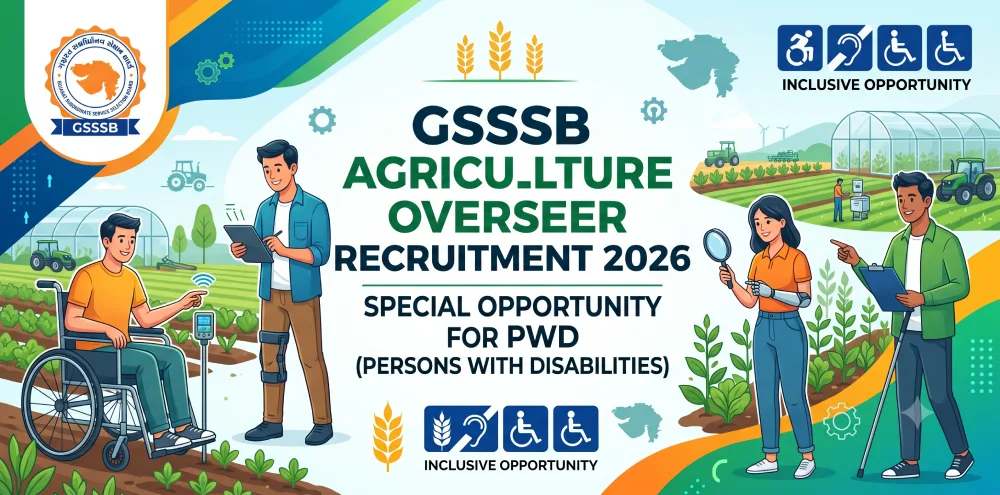
The Gujarat Secondary Service Selection Board (GSSSB), located in Gandhinagar, has recently published an official notification. This announcement concerns a special recruitment drive. It specifically targets Persons with Disabilities (PWD). This initiative is particularly significant for promoting inclusive employment. The advertisement number for this drive is 434/202627. Furthermore, it aims to fill a crucial Class-3 vacancy for the position of Agriculture Overseer. This role is within the Road and Building Department.
Eligible candidates are warmly invited to submit their applications online. The application process occurs through the official OJAS Gujarat portal. This special **GSSSB Agriculture Overseer Recruitment** represents a valuable opportunity. It allows disabled individuals to secure government employment in Gujarat. Prospective applicants must carefully review all detailed instructions. This step is essential before proceeding with their online applications. It helps to prevent any potential discrepancies. The application window is open from July 4, 2026, to July 18, 2026. Therefore, interested individuals should act promptly.
Understanding the Gujarat Secondary Service Selection Board (GSSSB)
The Gujarat Secondary Service Selection Board, widely known as GSSSB, serves a critical function. It is a prominent recruitment agency in Gujarat. Established by the state government, its primary mandate is to conduct examinations. Furthermore, it carries out selections for various non-gazetted posts. These positions fall under the Gujarat Civil Services. The board aims to ensure transparent and merit-based recruitment. This contributes significantly to the state’s administrative efficiency.
GSSSB plays a pivotal role in staffing numerous government departments. It manages recruitment for a wide array of sectors. These include health, education, administration, and technical roles. The board’s processes are meticulous. They involve multiple stages, from advertisement to final selection. This comprehensive approach ensures fairness for all applicants. Consequently, GSSSB is a trusted entity for job seekers in Gujarat. Its operations are vital for public service delivery.
The board’s commitment extends to upholding legal provisions. This includes those related to reservations and special drives. For example, the current drive focuses on Persons with Disabilities (PWD). Such initiatives demonstrate GSSSB’s dedication to social equity. They ensure that all segments of society have access to employment opportunities. Therefore, GSSSB not only fills vacancies but also reinforces social justice.
The Role of an Agriculture Overseer, Class-3
The position of Agriculture Overseer, Class-3, is integral to agricultural development. Specifically, within the Road and Building Department, this role takes on unique responsibilities. An Agriculture Overseer primarily oversees and manages horticultural aspects. This includes tasks related to greenery and landscaping. These efforts are crucial for various infrastructure projects.
An overseer’s duties can encompass several areas. They might supervise the planting and maintenance of trees along roadsides. Additionally, they could manage public parks and gardens. These green spaces are often associated with government buildings or infrastructure. Their work ensures ecological balance. Furthermore, it enhances the aesthetic appeal of public areas. This makes the urban and rural landscapes more pleasant.
Moreover, the role demands technical expertise in horticulture. Overseers provide guidance on plant health. They also manage irrigation systems. Pest control strategies fall under their purview too. They ensure proper soil management. This contributes to sustainable environmental practices. The expertise of an Agriculture Overseer is therefore essential. It supports the state’s green initiatives. These initiatives are often integrated into broader development plans.
The Road and Building Department relies on these specialists. Their contributions ensure that infrastructure projects are environmentally sound. They also make them visually appealing. Therefore, this Class-3 position holds significant importance. It bridges the gap between engineering and environmental stewardship. It is a critical link in integrated urban planning. This underscores the value of the **GSSSB Agriculture Overseer Recruitment**.
Pivotal Role of GSSSB Agriculture Overseer Recruitment for PWD
The special recruitment drive for Persons with Disabilities (PWD) holds immense importance. It reflects the government’s strong commitment to inclusivity. This initiative provides equitable employment opportunities. Such drives are crucial for a just society. They address historical disparities faced by PWD individuals.
Legislation like the Rights of Persons with Disabilities Act, 2016, mandates equal opportunities. It requires governments to reserve positions for PWD. This special **GSSSB Agriculture Overseer Recruitment** aligns with these legal frameworks. It ensures that PWD candidates are not excluded from public service. Instead, it actively seeks their participation. This policy creates a more diverse workforce. It also brings varied perspectives into government operations.
Challenges often confront PWD individuals in the job market. These include accessibility issues, discrimination, and lack of suitable opportunities. Special recruitment drives directly tackle these barriers. They create a dedicated pathway to employment. Moreover, securing a government job provides stability and dignity. This significantly improves the quality of life for PWD individuals. It also empowers them economically.
Beyond individual benefits, these initiatives have broader societal impacts. They promote a culture of empathy and acceptance. They also highlight the capabilities of PWD individuals. This helps to dismantle stereotypes. Therefore, such recruitment drives are not merely about filling vacancies. They are about building a more inclusive and equitable society. They demonstrate a progressive approach to human resources.
Detailed Eligibility Criteria for GSSSB Agriculture Overseer
Eligibility criteria are fundamental for any recruitment process. Candidates must meticulously review these requirements. This ensures they meet all necessary conditions. The GSSSB has outlined specific criteria for the Agriculture Overseer, Class-3 post.
Nationality and Domicile Requirements
Applicants must first satisfy nationality requirements. Candidates must be a citizen of India. This is a basic prerequisite for government employment. Alternatively, they must possess nationality as per the Gujarat Civil Services Classification and Recruitment (General) Rules, 1967. These rules detail specific conditions for employment in Gujarat’s civil services. They ensure that individuals serving the state meet the necessary legal status. This requirement underscores the importance of allegiance to the nation and the state.
Specifics of Benchmark Disabilities (PWD Focus)
This recruitment drive is exclusively designed for Persons with Disabilities (PWD). It falls under a special recruitment campaign. Therefore, only candidates with benchmark disabilities are eligible. The official advertisement specifies these disabilities. It categorizes them for the respective positions. Understanding these categories is crucial for applicants.
The categories of benchmark disabilities include:
- **LV (Low Vision) (40-70%) (Category A):** This refers to individuals with significantly impaired vision. Despite correction, they experience reduced visual acuity or visual field. However, they are not completely blind. The 40-70% range indicates the severity of vision loss. This means they possess a certain level of functional vision.
- **Deaf / Hard of Hearing (Category B):** This includes individuals with hearing loss. Deafness signifies profound hearing impairment. Hard of hearing indicates a moderate to severe loss. Communication challenges may arise, requiring assistive devices or specific communication methods.
- **Locomotor Disability, Leprosy Cured, Acid Attack Victims, Dwarfism, Muscular Dystrophy (Category C):** This is a broader category.
- **Locomotor disability** affects movement. It involves bones, joints, or muscles.
- **Leprosy cured** individuals face physical deformities or loss of sensation. These conditions are a result of leprosy.
- **Acid attack victims** often have severe facial and bodily disfigurement. This can impact mobility and social interaction.
- **Dwarfism** involves short stature due to genetic or medical conditions.
- **Muscular dystrophy** is a group of diseases. It causes progressive weakness and loss of muscle mass.
These conditions significantly impact an individual’s physical functions. They may require specialized support or accommodations.
- **Autism, Intellectual Disability, Specific Learning Disability, Mental Illness, Multiple Disabilities (Category D & E):** This category covers neurodevelopmental and mental health conditions.
- **Autism Spectrum Disorder** affects communication and social interaction. It also impacts behavior.
- **Intellectual disability** involves limitations in intellectual functioning. It also impacts adaptive behavior.
- **Specific learning disability** affects one’s ability to learn or use specific academic skills.
- **Mental illness** refers to conditions affecting mood, thinking, and behavior. These conditions may require ongoing treatment.
- **Multiple disabilities** occur when a person has two or more specified disabilities. This often leads to a combination of challenges.
These disabilities require a nuanced understanding. They often necessitate tailored support mechanisms. The special drive ensures that suitable candidates from these groups are considered.
Applicants must hold an official disability certificate. This certificate must confirm their benchmark disability. It must also specify the category they fall under. This documentation is mandatory for validating their eligibility.
Essential Educational Qualifications for GSSSB Agriculture Overseer
Meeting the educational requirements is critical for this position. Candidates must possess specific qualifications. These qualifications demonstrate their capability for the Agriculture Overseer role. All educational certificates must be valid by the application end date. This date is July 18, 2026.
Deep Dive into Diploma in Horticulture
To be eligible, candidates must possess a Diploma in Horticulture. This diploma must be obtained from a recognized institution. Specifically, it should come from a Polytechnic of any Agriculture/Horticulture University. This university must be incorporated or established under relevant Central or State Agriculture/Horticulture Universities Acts in India.
A Diploma in Horticulture typically provides comprehensive training. It covers various aspects of plant science and cultivation. Students learn about agronomy, soil science, and plant pathology. They also study entomology, which is the study of insects. Furthermore, the curriculum often includes landscaping design principles. Orchard management and protected cultivation techniques are also taught. Post-harvest technology forms another important part. This academic foundation is essential for an Agriculture Overseer. It enables them to effectively manage diverse horticultural tasks. The diploma ensures practical skills are acquired. These skills are vital for the duties expected in the Road and Building Department.
Computer Proficiency Requirement
Candidates must also possess basic knowledge of computer application. This is a mandatory requirement. It is prescribed in the Gujarat Civil Services Classification and Recruitment (General) Rules, 1967. In today’s administrative environment, computer literacy is indispensable. Basic knowledge generally includes proficiency in common office software. This covers applications like Microsoft Word, Excel, and PowerPoint. It also implies familiarity with internet browsing and email communication. The ability to input data accurately is also crucial. Furthermore, basic troubleshooting skills are often expected. This ensures efficient record-keeping and communication within the department. Therefore, this skill set is not merely desirable but essential. It supports modern administrative workflows.
Language Proficiency (Gujarati/Hindi)
Adequate knowledge of Gujarati or Hindi, or both, is another key requirement. This is particularly important for public service in Gujarat. Government officials regularly interact with citizens and colleagues. Communication primarily occurs in the local languages. Proficiency in Gujarati ensures effective interaction with the state’s populace. It facilitates understanding local agricultural practices and issues. Knowledge of Hindi further broadens communication capabilities. It is useful for interaction with central government bodies or non-Gujarati speakers. This linguistic competence is fundamental. It ensures smooth execution of duties. It also fosters better public relations.
All required educational qualifications and certificates must be held by the specified date. This date is July 18, 2026. Applicants must ensure that all details provided in the application form accurately match their original certificates. Any discrepancies could lead to disqualification.
Comprehensive Age Limit and Relaxation Policies
Age limits are a standard component of government job recruitments. They help in maintaining a balanced workforce. For the GSSSB Agriculture Overseer, Class-3 position, specific age criteria apply. Candidates must meet these requirements as of July 18, 2026.
General Age Limits
Applicants must be at least 18 years old. Simultaneously, they should not exceed 33 years of age. This provides a general framework for eligible candidates. The age range aims to attract both fresh talent and moderately experienced individuals. Adhering to these limits is non-negotiable for all applicants.
Detailed Breakdown of Age Relaxations
The GSSSB offers significant age relaxations for various categories. These provisions are designed to ensure fair representation. They also aim to support specific demographic groups. The maximum age limit, after applying relaxations, is capped at 45 years for most categories.
| Category | Age Relaxation (in years) | Maximum Age Limit (in years) |
|---|---|---|
| Women (General Category) | 5 | 45 |
| Men (Reserved Category) | 5 | 45 |
| Women (Reserved Category) | 10 | 45 |
| Persons with Disability (Men, General Category) | 10 | 45 |
| Persons with Disability (Women, General Category) | 15 | 45 |
| Persons with Disability (Men, Reserved Category) | 15 | 45 |
| Persons with Disability (Women, Reserved Category) | 20 | 45 |
| Ex-Servicemen | Service period + 3 | As per rules |
The rationale behind these relaxations is multifaceted.
- **Women:** Both general and reserved category women receive relaxations. This acknowledges the unique career breaks women often experience. It also promotes gender equality in the workforce.
- **Reserved Categories (Men & Women):** Candidates from Socially and Educationally Backward Classes (SEBC), Scheduled Caste (SC), Scheduled Tribe (ST), and Economically Weaker Section (EWS) benefit. These relaxations aim to uplift historically disadvantaged communities. They ensure their adequate representation in government service.
- **Persons with Disability (PWD):** PWD candidates receive substantial age relaxations. Men with PWD in the general category get 10 years. Women with PWD in the general category receive 15 years. Furthermore, PWD individuals in reserved categories get even more. Men get 15 years, and women get a significant 20 years. This extensive relaxation acknowledges the unique challenges PWD individuals face. It allows them more time to secure employment. It compensates for potential delays in education or career entry.
- **Ex-Servicemen:** Former military personnel are granted relaxation based on their service period. An additional three years are also added. This policy recognizes their invaluable service to the nation. It facilitates their reintegration into civilian employment.
These age relaxation policies are vital. They ensure a diverse and inclusive talent pool for government positions. Applicants must verify their eligibility under the specific categories. They should also ensure compliance with the maximum age limit.
Application Fees and Payment Modalities
The application fees for the GSSSB Agriculture Overseer Class-3 recruitment vary by category. This structure aims to make the application process accessible. It also covers administrative costs.
Fee Structure for Different Categories
General Category candidates are required to pay an application fee of Rs. 500/-. This is a standard charge for many government recruitments.
Reserved Category candidates, however, receive a concession. This includes women from all categories. It also covers Socially and Educationally Backward Classes (SEBC), Scheduled Caste (SC), Scheduled Tribe (ST), Economically Weaker Section (EWS), Persons with Disabilities (PWD), and Ex-Servicemen. These candidates must pay Rs. 400/-. This reduced fee supports equitable access to government employment. It alleviates financial burdens for specific groups.
Refund Policy Explained in Detail
A notable feature of this recruitment is the fee refund policy. The fees paid will be refunded to those candidates who appear for the examination. This encourages serious applicants. It also ensures that the financial burden is only temporary. The refund is typically processed after the examination. Candidates should retain their fee receipt for any future queries regarding refunds.
Online Payment Process Nuances
The application fees must be paid online. No other mode of payment will be accepted. The last date for online fee payment is July 21, 2026, at 23:59 hours. It is crucial to adhere strictly to this deadline. Candidates should ensure a stable internet connection during payment. They should also double-check payment details before submission.
After successful payment, candidates must obtain and retain a printout of the fee receipt. This receipt serves as proof of payment. It is essential for future reference or in case of any technical issues. The online payment system is designed for convenience. However, applicants should not wait until the last moment to pay. This helps in avoiding potential last-minute technical glitches.
The GSSSB Selection Process: A Detailed Examination
The selection process for the GSSSB Agriculture Overseer Class-3 post is well-defined. It involves a single-stage competitive examination. This process adheres to the rules set by the General Administration Department. The examination is designed to assess a candidate’s suitability for the role.
Overview of the Competitive Exam
The exam will be an Objective Type Multiple Choice Question (MCQ) based test. It can be either a Computer Based Response Test (CBRT) or an Optical Mark Recognition (OMR) based test. This format ensures standardized evaluation. It also minimizes subjective bias. The question paper will comprise two distinct parts. These are Part-A and Part-B. The combined duration for both parts is 3 hours (180 minutes). This allows ample time for candidates to complete the examination.
In-depth Explanation of Part-A (90 Marks)
Part-A focuses on general aptitude and knowledge. It carries a total of 90 marks. This section is designed to evaluate a candidate’s foundational skills. These skills are essential for government service.
- **Logical Reasoning & Data Interpretation (30 Marks):** This segment assesses a candidate’s analytical abilities. It also evaluates problem-solving skills. Logical reasoning questions test critical thinking. Data interpretation involves analyzing charts, graphs, and tables. These skills are vital for administrative decision-making.
- **Mathematical Aptitude (30 Marks):** This part evaluates numerical ability. It covers basic arithmetic, algebra, and geometry. Questions might involve percentages, ratios, time and work, or profit and loss. Strong mathematical aptitude is necessary for various administrative calculations.
- **Indian Constitution, Current Affairs, Gujarati & English Comprehension (30 Marks):** This section is broad.
- **Indian Constitution** knowledge is fundamental for government employees. It ensures understanding of legal frameworks and governance.
- **Current Affairs** keep candidates informed about national and international events. This awareness is important for civic engagement and policy understanding.
- **Gujarati & English Comprehension** tests language proficiency. It assesses the ability to understand and interpret written text. These skills are crucial for official communication and documentation.
Collectively, these sub-sections ensure a well-rounded candidate. They are prepared for diverse public service demands.
In-depth Explanation of Part-B (120 Marks)
Part-B is subject-specific. It carries 120 marks. This section directly assesses knowledge related to Horticulture. The questions will focus on core concepts and applications within the field.
Horticulture topics can cover a wide array of subjects. These include:
- **Agronomy:** Principles of crop production, soil management, and fertility.
- **Plant Physiology:** Understanding plant growth, development, and metabolic processes.
- **Plant Pathology:** Identification and management of plant diseases.
- **Entomology:** Study of insect pests and their control in horticultural crops.
- **Fruit and Vegetable Science:** Cultivation practices, varieties, and management of various fruits and vegetables.
- **Floriculture and Landscaping:** Principles of flower cultivation, ornamental plants, and landscape design.
- **Post-Harvest Technology:** Techniques for handling, storage, and processing of horticultural produce.
- **Seed Technology:** Production, processing, and quality control of seeds.
- **Agricultural Extension:** Dissemination of agricultural information and technologies to farmers.
A deep understanding of these areas is paramount. It ensures that the Agriculture Overseer can effectively perform their duties. This includes managing green infrastructure projects.
Negative Marking Implications
There will be a negative marking of 1/4th of the marks allotted for each incorrect answer. This policy encourages accuracy. It also discourages random guessing. Candidates must therefore be careful while attempting questions. A wrong answer can reduce their overall score. This penalty system ensures that only genuinely known answers contribute positively.
Significance of Minimum Qualifying Marks (40%)
Candidates must secure a minimum of 40% marks in Part-A. They also need a minimum of 40% marks in Part-B. It is important to note that no relaxation in these qualifying marks is provided for any category of candidates. This means all applicants, regardless of their background, must meet this minimum standard. This ensures a baseline level of competence across all selected candidates. It maintains the quality of government service.
Post-Exam Procedures
Provisional answer keys will be released shortly after the examination. This allows candidates to estimate their scores. It also provides an opportunity for review. Candidates can raise objections against these provisional keys if they find discrepancies. Following the consideration of all valid objections, a final answer key will be published. This transparent process ensures fairness in evaluation.
Step-by-Step Guide to Online Application through OJAS
Applying online requires careful attention to detail. The OJAS portal is user-friendly. However, following each step correctly is vital. This ensures a successful application for the **GSSSB Agriculture Overseer Recruitment**.
Pre-application Checklist
Before starting the online application, gather all necessary documents. This includes educational certificates, disability certificates, and age proof. Keep a scanned copy of your photograph and signature ready. Ensure they meet the specified technical dimensions and file size. A stable internet connection is also essential.
Detailed Steps from Website Visit to Final Confirmation
Eligible candidates must apply online through the OJAS portal. Follow these steps meticulously:
- **Step 1: Visit the Official OJAS Gujarat Website.** Navigate to https://ojas.gujarat.gov.in. This is the official gateway for government job applications in Gujarat.
- **Step 2: Access the Online Application Tab.** On the homepage, locate and click on the “Online Application” tab. This will lead you to the application section.
- **Step 3: Select Board/Commission.** From the list of Boards/Commissions, choose “Apply” and then select “GSSSB.” This filters the advertisements relevant to the Gujarat Secondary Service Selection Board.
- **Step 4: Find the Specific Advertisement.** Search for advertisement number 434/202627. It will be for “Agriculture Overseer, Class-3.” Click on “More Details” to read the full notification. After reviewing, click “Apply Now.”
- **Step 5: Fill in Personal Details.** The application format will open. First, accurately fill in all mandatory “Personal Details.” These fields are marked with a red asterisk (*). Ensure all information matches your official documents.
- **Step 6: Enter Educational Details.** Proceed to fill in your “Educational Details.” Provide accurate information regarding your qualifications and institutions.
- **Step 7: Save Application and Obtain Application Number.** Accept the “Assurance” by clicking “Yes” and then “Save.” This action is crucial. It generates your unique Application Number. Make sure to save this number carefully. It is vital for all future interactions.
- **Step 8: Upload Photograph and Signature.** Go to the “Upload Photograph” section. Enter your Application Number and Birth Date. Upload your scanned photograph and signature.
Crucial Points for Photo and Signature Upload
The photograph dimensions should be 5 cm height x 3.6 cm width. The signature dimensions should be 2.5 cm height x 7.5 cm width. Both must be in JPG format. Furthermore, each file must not exceed 15 KB. The photograph must have a white background. It also needs to be taken within one year from the application end date. Strict adherence to these specifications is crucial for a valid application. Non-compliance can lead to rejection.
- **Step 9: Confirm Application.** Return to the “Online Application” tab. Click “Confirm Application.” Enter your Application Number and Birth Date. Once confirmed, no changes can be made to the application. Therefore, review all details thoroughly before this step.
- **Step 10: Print Application.** After successful confirmation, click on “Print Application.” Print out your application form. Retain a copy for your records and future reference.
- **Step 11: Pay Application Fees Online.** Pay the application fees online by the specified last date. This date is July 21, 2026. Ensure you obtain a printout of the fee receipt. This is your proof of payment.
Following these steps precisely will help avoid errors. It will also ensure that your application is successfully submitted.
Crucial Dates and Deadlines
Adhering to deadlines is paramount for any job application. The GSSSB Agriculture Overseer recruitment has several important dates. Applicants must be aware of these to ensure timely submission.
| Event | Date |
|---|---|
| Official Notification Release Date | 03/07/2026 |
| Application Start Date | 04/07/2026 (14:00 hours) |
| Application End Date | 18/07/2026 (23:59 hours) |
| Eligibility, Age, NCLC, EWS, Caste Certificate Date | 18/07/2026 |
| Last Date for Online Fee Payment | 21/07/2026 (23:59 hours) |
The official notification was released on July 3, 2026. This started the application cycle. Online applications began on July 4, 2026, at 2 PM. This gave candidates a specific window. The application submission window closes on July 18, 2026, at 11:59 PM. This is also the cut-off date for all eligibility criteria. This includes age, educational qualifications, and certificate validity. Furthermore, the last date for online fee payment is slightly later. It is July 21, 2026, at 11:59 PM. Candidates should plan their application and payment well in advance. This approach helps to avoid any last-minute technical issues. Timely submission is key to participating in this special recruitment drive.
Key Takeaways for Aspiring Agriculture Overseers
This special recruitment drive offers a significant opportunity. It targets Persons with Disabilities (PWD). The position is for a single Agriculture Overseer, Class-3 post. Here are the critical points to remember:
- This recruitment is exclusively for PWD candidates. It fills one specific Agriculture Overseer, Class-3 position.
- Candidates must hold a Diploma in Horticulture. This diploma should be from a recognized university. Additionally, basic computer knowledge is mandatory.
- Age limits and relaxations are clearly defined. Ensure strict compliance by the application end date. This date is July 18, 2026.
- The selected candidate will receive a fixed salary of Rs. 40,800/- for the first five years. Subsequently, a regular pay scale as per Level-5 will apply.
- The selection process involves an MCQ-based competitive examination. It includes negative marking. Candidates must achieve a minimum qualifying score of 40% in both Part-A and Part-B. No relaxation applies to these minimum scores.
- Application fees vary by category. Importantly, they are refundable if the candidate appears for the examination.
- Strict adherence to photo and signature upload guidelines is crucial. This includes specific dimensions and file size. It ensures a valid application.
- Applicants are advised to regularly check the GSSSB website. This is important for updates, exam schedules, and call letters.
These points summarize the essence of the recruitment. They provide a clear roadmap for prospective candidates.
Final Thoughts
The GSSSB Agriculture Overseer Class-3 recruitment for PWD candidates presents a valuable opportunity. This special drive enables eligible individuals to secure a government position. Such initiatives are vital for fostering an inclusive workforce. They ensure equal opportunities for all citizens.
It is imperative for all applicants to meticulously review the official notification. This guarantees they meet all eligibility criteria. Moreover, a complete understanding of the application process is essential. Paying close attention to application deadlines is crucial. Furthermore, preparing all required documents beforehand is highly recommended. A thorough grasp of the detailed exam pattern will significantly enhance the chances of a successful application.
This special recruitment drive truly underscores the government’s commitment. It aims to foster inclusive employment. It also provides equitable opportunities for Persons with Disabilities. We strongly encourage all interested and eligible PWD candidates to apply online. This should be done well before the closing date. This proactive approach helps to avoid any last-minute technical issues. Seizing this opportunity can pave the way for a stable and rewarding career in public service.
For more real-time news updates and announcements, visit our homepage.