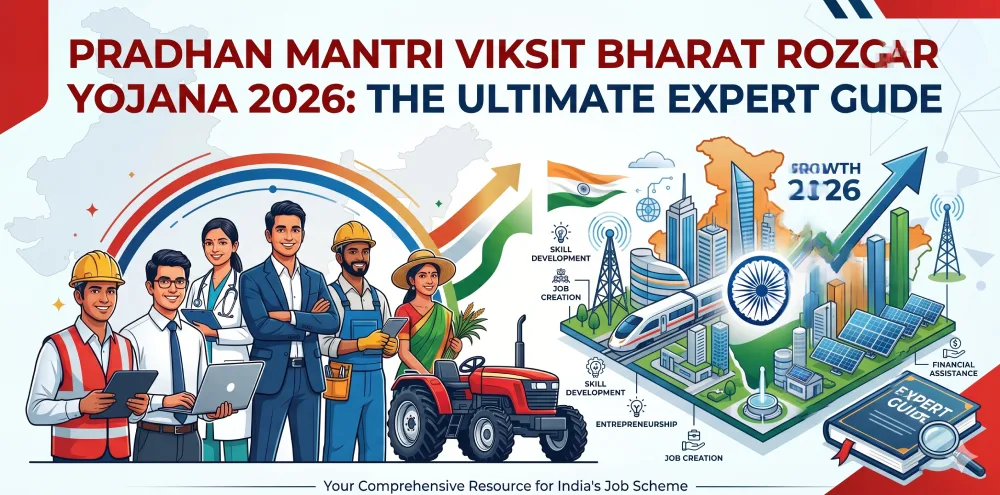
In an unprecedented move to formalize the Indian workforce and harness the nation’s demographic dividend, the Central Government has officially initiated the full-scale rollout of the Pradhan Mantri Viksit Bharat Rozgar Yojana (PMVBRY) as of April 2026. Forming the bedrock of the Prime Minister’s comprehensive ₹2 Lakh Crore Package for Employment and Skilling, this Employment-Linked Incentive (ELI) Scheme is meticulously designed to generate millions of formal jobs over the next five years. For fresh graduates, first-time job seekers, and corporate employers alike, PMVBRY represents a paradigm shift in how the government incentivizes job creation. By leveraging India’s robust Digital Public Infrastructure (DPI) and direct benefit transfers, the scheme directly targets the root causes of unemployment while reducing the financial burden of new hires on the corporate sector.
This comprehensive guide dives deep into the architecture of the PMVBRY, decoding its multi-tiered incentive structures, stringent eligibility criteria, macroeconomic implications, and the technologically advanced registration protocols required to secure these benefits.
The Macroeconomic Vision: Why PMVBRY Matters in 2026
To understand the gravity of the Pradhan Mantri Viksit Bharat Rozgar Yojana, one must look at the broader economic landscape of India navigating its path toward “Viksit Bharat@2047” (Developed India by 2047). While GDP growth has remained resilient, the critical challenge has been “jobless growth”—where economic expansion outpaces formal job creation. The PMVBRY directly addresses this friction by intervening at the very moment a youth enters the formal workforce.
The scheme transitions the government’s approach from passive employment exchanges to active, financial intervention. By directly subsidizing the Employees’ Provident Fund Organisation (EPFO) contributions for both the employee and the employer, the government is effectively lowering the cost of formal hiring. This structural reform not only brings unorganized workers into the social security net but also encourages micro, small, and medium enterprises (MSMEs) to legitimize their workforce without fearing immediate overhead spikes.
PMVBRY 2026 Scheme Overview & Strategic Framework
The operational framework of the scheme is heavily reliant on real-time data integration between the EPFO, the Ministry of Labour and Employment, and corporate payroll systems. Below is a high-level overview of the scheme’s core parameters.
| Strategic Parameter | Expert Details & Specifications |
|---|---|
| Scheme Nomenclature | Pradhan Mantri Viksit Bharat Rozgar Yojana (Employment-Linked Incentive) |
| Financial Outlay | Part of the ₹2 Lakh Crore Prime Minister’s Package over 5 Years |
| Target Demographic | First-time employees entering the formal workforce (registered via EPFO) |
| Wage Ceiling for Eligibility | Applicable to salaries up to ₹1,00,000 per month |
| Technological Backbone | UMANG App, Aadhaar Face Authentication Technology (FAT), EPFO Portal |
| Primary Objective | Catalyze formalization, boost manufacturing jobs, and support MSME hiring |
Decoding the Three Pillars of the Employment-Linked Incentive (ELI)
The PMVBRY is not a monolithic policy; it is intelligently segmented into three distinct schemes (A, B, and C) to address different friction points in the labor market. Expert analysts note that this targeted approach prevents systemic leakage and ensures funds reach the intended beneficiaries.
Scheme A: Direct Wage Support for First-Timers
Scheme A is fundamentally a Direct Benefit Transfer (DBT) aimed at the youth. The government will provide a one-month wage to all persons newly entering the formal workforce across all sectors. The subsidy is calculated as one month’s Provident Fund (PF) contribution, capped at ₹15,000, and is disbursed directly to the employee’s bank account in three structured installments. This acts as a powerful onboarding bonus and a safety net for fresh graduates transitioning from tier-2 and tier-3 cities to major corporate hubs.
Scheme B: Job Creation in Manufacturing
Recognizing that sustainable economic growth requires a robust manufacturing base, Scheme B offers amplified incentives specifically for the manufacturing sector. This pillar subsidizes the EPFO contributions for both the employee and the employer for the first four years of employment. By linking the incentive to a four-year tenure, the government is discouraging high attrition rates and promoting long-term skill acquisition on the factory floor. This aligns perfectly with the broader Production Linked Incentive (PLI) schemes, providing factories not just with capital subsidies, but human capital subsidies.
Scheme C: Comprehensive Support to Employers
Scheme C focuses on the demand side of the employment equation—the employers. For every additional employee hired outside of the manufacturing sector, the government reimburses employers up to ₹3,000 per month towards their EPFO contribution for a duration of two years. This is specifically designed to aid the services sector, IT infrastructure, and retail, significantly reducing the “tax” on formalizing jobs and encouraging companies to expand their payrolls aggressively during the 2026 financial year.
Strict Eligibility Criteria: Who Actually Qualifies?
To ensure the fiscal discipline of the ₹2 Lakh Crore package, the Ministry has established rigorous guardrails. Understanding these prerequisites is critical for both HR compliance teams and job seekers.
Prerequisites for Employees
- First-Time Registration: The individual must have never been registered with the EPFO prior to the scheme’s notification date.
- Salary Cap: The gross monthly wage of the new recruit must not exceed ₹1,00,000. This ensures the benefit is targeted at lower and middle-income brackets.
- Aadhaar Seeding: A fully updated, Aadhaar-linked Universal Account Number (UAN) and a KYC-compliant bank account are mandatory for direct benefit transfers.
- Mandatory Skilling: In certain state-level variations of the scheme, candidates must complete a brief orientation via the Skill India Digital Hub.
Prerequisites for Employers
- EPFO Registration: The employing entity must have a valid EPFO registration and a clean track record of compliance.
- Baseline Employment Expansion: Employers must demonstrate a net increase in their employee base. Firing existing workers to hire new ones under the scheme will trigger severe penalties and disqualification.
- Timely Returns: Employers must file their Electronic Challan cum Return (ECR) strictly on time; delayed filings result in the forfeiture of that month’s subsidy.
Step-by-Step UAN Generation via UMANG App (2026 Update)
A major bottleneck in previous government schemes was the bureaucratic friction of registration. In 2026, the government has entirely digitized this through the Unified Mobile Application for New-age Governance (UMANG). Furthermore, the introduction of Face Authentication Technology (FAT) eliminates the need for physical biometric scanners or OTPs delayed by network issues.
Digital Onboarding Protocol for Job Seekers
- Step 1: Application Initialization: Download the latest 2026 build of the UMANG App from the Google Play Store or Apple App Store. Ensure your mobile number is the one linked to your Aadhaar card.
- Step 2: Accessing EPFO Services: Search for the “EPFO” module within the app dashboard. Select “Employee Centric Services” and tap on “Generate UAN for Unorganized/First-Time Worker.”
- Step 3: Aadhaar and FAT Verification: Input your 12-digit Aadhaar number. When prompted, grant camera permissions. The app will utilize the UIDAI’s Face Authentication Technology. Ensure you are in a well-lit room and hold the camera steady for a live liveness check.
- Step 4: Demographic Confirmation: Once authenticated, the system will auto-populate your demographic data (Name, DOB, Address). Verify these details carefully. Any mismatch here will stall the DBT process.
- Step 5: UAN Generation: Submit the application. Your 12-digit Universal Account Number (UAN) will be generated instantly and sent via SMS. This UAN must be provided to your HR department on day one of your new job.
Sectoral Impact: How PMVBRY Shapes Corporate Strategy
From a corporate governance and HR strategy perspective, PMVBRY is a game-changer. Large IT conglomerates and emerging tech startups are already recalibrating their hiring algorithms for the Q3 and Q4 cycles of 2026.
For MSMEs, which traditionally run on razor-thin margins, the cost of formal compliance (roughly 12% to 13% of basic salary towards EPF) has historically been a deterrent to formal hiring. By absorbing this cost via Scheme C, the government is allowing small businesses to scale operations legally. Furthermore, companies are leveraging this scheme to boost their Environmental, Social, and Governance (ESG) scores, as formalizing labor directly impacts the ‘Social’ pillar of corporate reporting.
We are also seeing a strategic shift in campus recruitment. Because the incentives are strictly for “first-time” EPFO members, universities and technical institutes are advising graduating batches to pre-generate their UANs to make themselves more attractive, “subsidy-ready” candidates for campus recruiters.
Navigating Common Hurdles and Disqualifications
Despite the robust digital infrastructure, applicants and employers must be wary of common pitfalls that can derail the incentive process.
Critical Troubleshooting Areas
- Name Mismatches: The most common reason for DBT failure is a spelling discrepancy between the Aadhaar database, the EPFO portal, and the Bank Account. Absolute parity is required.
- Dormant Bank Accounts: Ensure the bank account linked to the UAN is active, KYC updated, and capable of receiving direct transfers (DBT-enabled).
- Employer Compliance Lapses: If an employer misses the 15th-of-the-month deadline for filing PF returns, the government subsidy for that specific month is irrevocably lost for both the employer and the employee.
Future Outlook: The Road Ahead for India’s Youth
The Pradhan Mantri Viksit Bharat Rozgar Yojana is more than just a financial subsidy; it is a structural intervention aimed at altering the DNA of the Indian labor market. By financially incentivizing formalization, the government is not only ensuring immediate job creation but is also building a massive, data-rich registry of the national workforce. As we move deeper into 2026, companies that swiftly integrate PMVBRY protocols into their talent acquisition pipelines will secure a significant competitive advantage in capturing top-tier fresh talent.
The employment landscape is shifting rapidly. Are you an employer restructuring your hiring plans, or a fresh graduate preparing for your first role? Ensure your digital credentials are in order today. Subscribe to our expert newsletter for real-time policy updates, deep-dive economic analyses, and the latest government recruitment notifications to stay ahead of the curve.