🚀 Breaking News Update
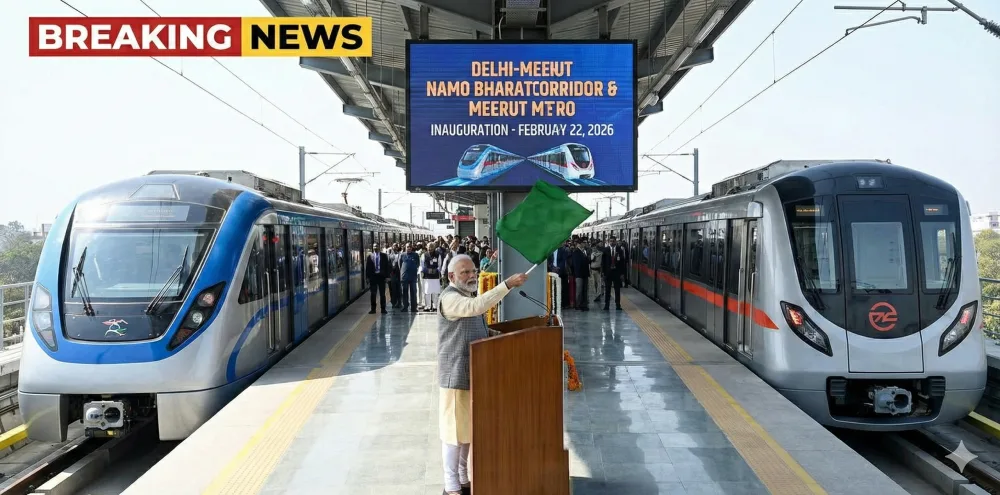
Today marks a historic milestone in India’s infrastructure journey. Prime Minister Narendra Modi has officially flagged off the full 82-km Delhi-Meerut Namo Bharat Regional Rapid Transit System (RRTS) and the Meerut Metro. This dual-transit system is set to redefine travel between the National Capital and Western Uttar Pradesh.
Why This Launch is Historic
The inauguration of the full corridor is not just about a new train; it is about the convergence of speed, technology, and economic integration. For the first time in India’s history, two distinct transit systems—the high-speed Regional Rapid Transit (RRTS) and a local Metro system—are operating on the same infrastructure.
This “Make in India” marvel significantly reduces the travel time between Delhi and Meerut from the current 3-4 hours by road to less than 60 minutes.
Detailed Project Specifications
The following data table provides a comprehensive snapshot of the project’s magnitude, costs, and technical capabilities.
| Feature | Specification / Detail |
|---|---|
| Project Name | Delhi-Meerut RRTS (Namo Bharat) & Meerut Metro |
| Total Corridor Length | 82.15 km |
| Total Stations | 25 (Includes RRTS & Metro Stations) |
| Operating Speed (RRTS) | 160 kmph (Design Speed: 180 kmph) |
| Operating Speed (Metro) | 120 kmph (Fastest Metro in India) |
| Project Cost | Approx. ₹30,274 Crore |
| Funding Agencies | Asian Development Bank (ADB), NDB, AIIB, Govt of India |
| Travel Time (End-to-End) | < 55 Minutes (Delhi to Meerut) |
| Daily Ridership Capacity | 8,00,000+ Passengers |
Key Features of the Namo Bharat & Meerut Metro
This project introduces several “firsts” for the Indian railway sector. Below are the standout features that make this corridor unique:
- Multi-Modal Integration: The system seamlessly connects with other transport modes. For instance, the Sarai Kale Khan station connects the RRTS with the Hazrat Nizamuddin Railway Station, the Delhi Metro (Pink Line), and the ISBT.
- Premium & Standard Class: The Namo Bharat trains feature a dedicated “Premium Class” coach with reclining seats, extra legroom, and coat hooks, alongside standard coaches.
- Women-Only Coach: Every train includes a dedicated coach for women to ensure safety and comfort during commutes.
- High-Frequency Service: Trains are designed to run every 5 to 10 minutes, ensuring zero waiting time fatigue for daily commuters.
- Green Energy: A significant portion of the energy requirements for the corridor is met through solar power generated at stations and depots.
Technological Innovations (For Tech Enthusiasts)
Since our readers love technology, here is a breakdown of the advanced tech stack powering this corridor:
- ETCS Level 2 Signalling: The corridor uses the European Train Control System (Level 2)
over
LTE radio, a first for India, ensuring high-speed safety and interoperability. - Platform Screen Doors (PSDs): All stations are equipped with PSDs integrated with the signaling system to prevent accidents and save energy.
- Aerodynamic Design: The Alstom-manufactured trainsets utilize an aerodynamic stainless steel body to reduce drag at high speeds (180 kmph).
- Regenerative Braking: The trains feed energy back into the grid during braking, making the system highly energy-efficient.
Economic Impact on NCR
The inauguration today is expected to trigger a massive economic shift in the National Capital Region (NCR).
- Real Estate Boom: Areas like Modinagar, Muradnagar, and Shatabdi Nagar are already witnessing a surge in property demand due to improved connectivity.
- Job Creation: The ease of travel allows people living in Meerut to work in Delhi/Gurgaon and return home daily, effectively expanding the labor market.
- Decongestion: The shift of traffic from road to rail will significantly reduce vehicular pollution and congestion on the Delhi-Meerut Expressway.
Conclusion
With Prime Minister Modi dedicating this project to the nation today, India takes a giant leap towards world-class urban mobility. The Delhi-Meerut RRTS is not just a transport project; it is a blueprint for future high-speed corridors planned for Alwar and Panipat. For daily commuters, the nightmare of traffic jams is finally over.
Stay tuned to our blog for live updates on ticket pricing and the full schedule release later today!